Tuesday, December 7, 2010

Remaining Architectural Old Details at Kampung Kauman


Kampung Kauman is an old traditional Muslim Community settlement that is situated near the Main Mosque in the Cities at Java Island. Most probably, the settlement old is almost as similar as the Main Mosque itself. According to the original old 'city planning' order, Kampung Kauman is usually located in the west side of the 'Alun-alun' as the Old City Square that refer to the direction of Mecca City at The Arabia Peninsula.


There are some remaining old houses and buildings that captured in the pictures here might be could be used as reflection of old time glimpse about how Kampung Kauman and Masjid Kauman surrounding areas are look like.


Today, The Kampung is no longer situated in a spacious open city landscape, since 'Alun-alun' as The Old City Square is already gone and transformed into many of commercial buildings. Now, The Kampung physically is remaining as like typical dense urban settlement in the City. Maybe, only The Kauman Mosque remains exist as 'historical and cultural pair' and still stand as its origin until today


Monday, December 6, 2010

Masjid Kauman, Remaining Building from the Lost Old City Square


Currently, Kauman Mosque (Masjid Kauman) is identified as an old large mosque that is situated in the middle of busy commercial area of Pasar Johar. Originally, this mosque was a part of 'Alun-alun' complex, a Javanese architectural term that related with a very large public open square as a kind of city center. Nowadays, this large open square could not be found anymore, since it already converted into many of commercial buildings. And this old city center is already lost and maybe changed to other part of the city.


The Kauman Mosque is noted in the history that closely related with the early origin of Semarang City. Most probably, major renovation works have already eliminated most of its original physical appearances. At least we can still identify its unique roof with its 'Meru'-like shape that is decorated with sculptural floral shapes as its main crown. A typical roof top detailing that always found in many old Javanese Mosque, particularly in Central and East Java Regions.


Wednesday, November 17, 2010

Pasar Johar, a Building With Hundred of Octagonal Skylights


Currently, the building of this traditional central market building looks as a messy old building that surrounding by other new buildings. From day to day Pasar Johar always surrounding by large numbers of peoples who involve in traditional daily trading activities, because Pasar Johar might be the remaining largest traditional market in Semarang City where traditional traders meet with the customers.
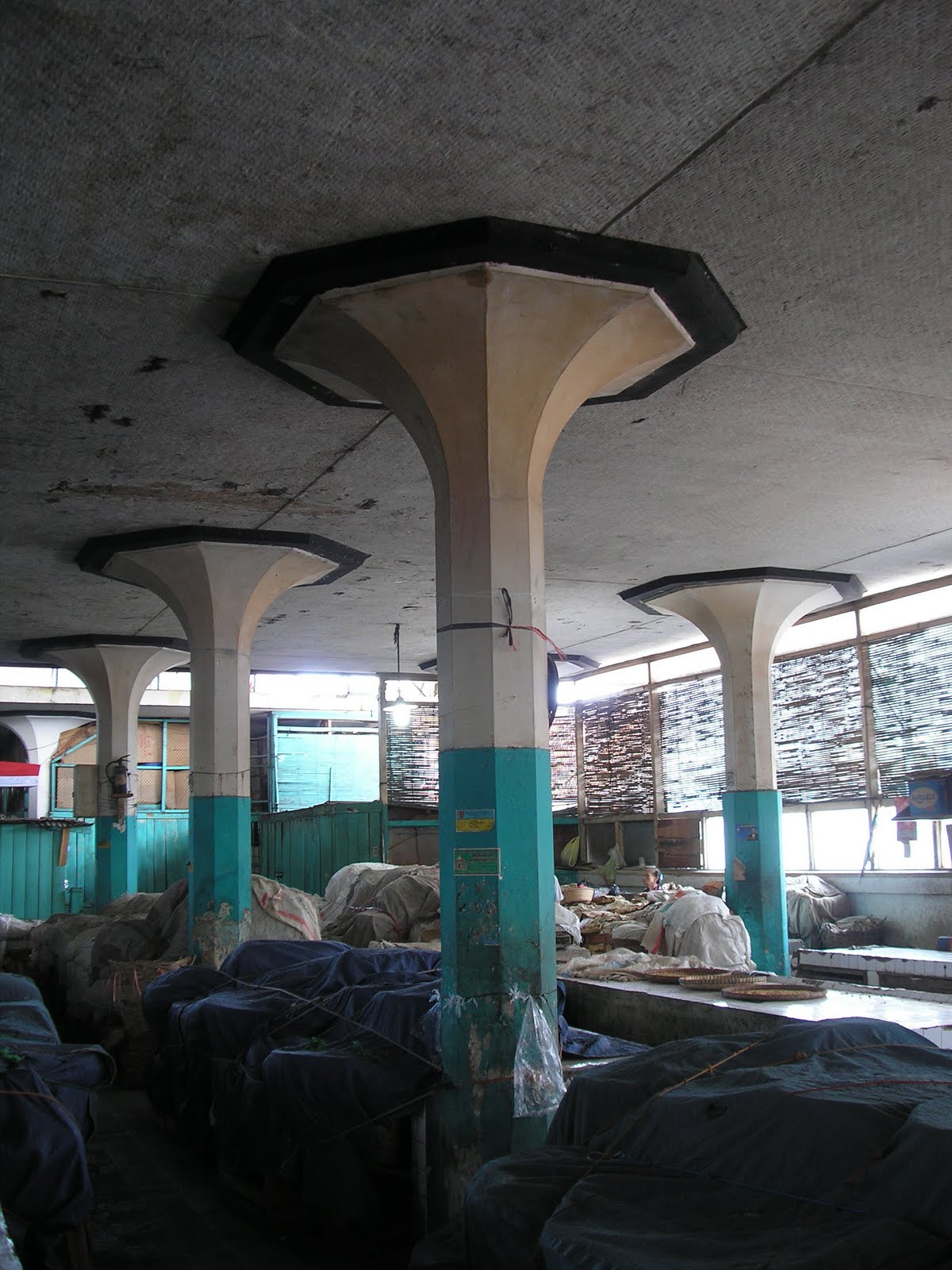
When we come to enter the inside of the building, I think we can directly recognize 'the beauty' of the building. Under the huge large flat concrete roof we can find spacious internal spaces that consist of two floors with large atrium in the middle. Since the building is designed and built during Dutch Colonial Era, this building should be one of the largest modern market building in that era. The design was generated in modern approaches.


There are specific details we can find here are the interesting octagonal shaped roof skylights and many of typical structural columns with mushroom shapes that support the large flat concrete roof. If we zoom the building in from "Google Map" we can calculate that there are more than a hundred of octagonal skylights on the roof of Pasar Johar. Skylights that promote tropical daylights come through to the internal space of market and also enable natural air circulations.


Nowadays, Pasar Johar still alive within its functions a smain central traditional market in Semarang where can find most of daily needs such as books, magazine, shoe, textiles, vegetables, fresh meat and others. Today, Pasar Johar still looks busy and always crowded with peoples with their daily traditional trading activities.


Tuesday, November 9, 2010

Masjid Kampung Layur, an Old Small Mosque with a High Minaret


There is an old small mosque that is situated slightly hidden in the middle of "Kampung Layur", a dense quarter near busy commercial area of Johar Semarang. The quarter itself is originated in 18th Century. The existence of the mosque could be identified from the distance by the appearance of its tower that is raising high in between crowded housing scenery. A high elaborate minaret for muadzin to calls the prayers. By that time, the existence of this round masonry high minaret is not something typical in common mosque in Central Java.


This small old mosque is situated about 700 meters away from The Kauman Mosque at "Pasar Johar" area or about 400 meter from "Hotel Dibya Puri". In the past time, this mosque is situated in the middle of busy ship loading and unloading harbor area. And today the mosque is slightly recessed in the middle of urban quarter, not far away from central commercial area.
This mosque also known as Masjid Kampung Melayu.


The main part of the mosque is a small square building with its "Meru' like roof that hidden inside a high masonry wall fence. Just like typical mosque in Central Java, the roof top is decorated with sculptural crown object that is consisting of breadnut leaves and cudgel shapes, instead of crescent moon and star.
Window details are interesting, particularly on the detail of its perforated louvers with repetition of "Arabic" geometrical star shape patterns. Its combination with green transparent glass on window transom creates a simply beautiful daylight reflection through the interior spaces.


This small mosque seem like a small garden where two different flowers are growing together as a symbol and reflection of take and give process where two different cultures are met together and understand each other in mutual orders.


Saturday, November 6, 2010

Hotel Dibya Puri; an Old Hotel at Bodjong Street


Currently, "Hotel Dibya Puri" is an old empty building that is situated in a busy crossroad in Semarang City. The hotel actually was placed in a prominent spot at the crossroad off amous old Bodjong Street and other roads that lead to "Pasar Johar" the old central market and old parade square (alun-alun).


The hotel itself is originally built during Dutch Colonial Era and become one of famous city landmark near Johar Area, a busy business and commercial area in Semarang. The hotel existence could be identified by its simple symmetrical and geometrical shapes. The main entry is situated in the middle part of the building, room bays are placed in two different wings that are ended with the existence of three storey towers (at each sides).


The building is properly set back away from the Main Street and pedestrian lines. and trees around its parking area nicely provide green covers that conceal the building from busy ambience of Johar Area. It should be a nice spot for a city hotel, but nowadays the building remains empty.


Sunday, October 24, 2010

"Toko Oen": Remaining Old Retail Store at Bodjong Street


When somebody takes a walk and passes through the pedestrian in front of "Toko Oen", there is a small signage:"Since 1936" sticks on its glass shop front, This is a self explanation about how old the store was. This was about nine years before the Indonesian's Independence Day.


Currently, the store looks very aged and distracted with the existence of large 'busy' street billboard, street trader's umbrella and slightly concealed behind pedestrian trees. The store's entry is situated at the curved corner-end side that facing to Bodjong Street's T-intersection with a small street. The Roof top signage is directly placed above this entry corner side that slightly facing to the famous 'Old City' Area.


Tuesday, October 12, 2010

Toko "Naga Mas"; Remaining Old Retail Store at Bodjong Street


The address of the store is self explanatory in an embossed plaster signage text that is still displayed on the existing building facade wall. "Bodjong" was the old name of Pemuda Street before Indonesian Independence Era. Based on this it could be predicted that Toko "Naga Mas" is one of remaining old store at Pemuda Street Semarang.

The building is situated near Toko "Nam Bie" and placed directly at the cross road of Pemuda Street and Gajah Mada-Gendingan Street. The building is a single mass masonry building with a feature box tower. Different with The Pertamina Building (as described in my previous blog article), which is used to place building signage, the feature tower at Toko "Naga Mas" remains as 'blank' box tower.


As also shown and described on the other side of the existing facade signage that facing to north-east side, Toko "Naga Mas" is originally a shoe and bag store. The appearance of the building itself actually is not too big in a matter of size (compare to Toko "Nam Bie"), but visually it looks prominent enough from every point of the cross road area. The existence of an old public mail box in red orange color at the corner-end of the pedestrian, I think elaborates the building's 'vintage' look.