Wednesday, May 2, 2012

Jomblang Reservoir, and a Silhouette of a Dome on a Hill


Jomblang Reservoir is another remaining old clean water reservoir in Semarang that built during Dutch Colonial Era. Jomblang reservoir looks slightly bigger than The Siranda Reservoir. As similar as Siranda Reservoir, the building consist of two big domes.The appearance of the reservoir building is always visible as a silhouette of big dome with a cupola tower on Tanah Putih Hill.


The reservoir building is situated about 300 meter from 'Pasar Kambing Mrican' the goats market. The Jomblang Reservoir is part of Tanah Putih uphill road scenery. Always concealed under the lush big trees around Tanah Putih Hill.


Actually, the building appearance of Jomblang Reservoir is similar as the first older reservoir building belong to Siranda Reservoir. It also found at the Jomblang Reservoir same grass covered big domes, same small copula tower on the of the dome and also same entry facade. Anyway, the existence of these two old clean water reservoir buildings becomes one of the evidence that originally Semarang City is already well planned since almost hundred years ago.


Tuesday, May 1, 2012

Pasar Kambing Mrican, a Traditional Goats Market at the Traffic Lights


The place is situated less than one kilo meter from Peterongan market place, directly situated at the traffic light at the intersection of 'Mrican' Street and south end side of Mataram Street. Yes, this is a goats market, a place where we can found street traders who sell life goats. There is a goat statue that could be found as a sign of  market existence.


There is a row of bamboo shed at one of street pedestrian side where the traders displaying the goats. At the peak selling time the goats just loosely displayed along the both street pedestrian sides around the traffic lights area. Traditionally, the peak selling time is around the Eid al-Adha', an Islamic annual holiday. The need of life goats is also related with another traditional Moslem's need to sacrifice of an animal, particularly goat on the occasion of a child's birth.


When Semarang Citizens mention about goat market, it will always refers to this place as an almost semi permanent market place that sells life goats. Actually, this is one of another unique traditional market places that are still found in Semarang City.


Sunday, April 15, 2012

Pasar Peterongan, a Traditional Market and Legend of an Old Tamarind Tree


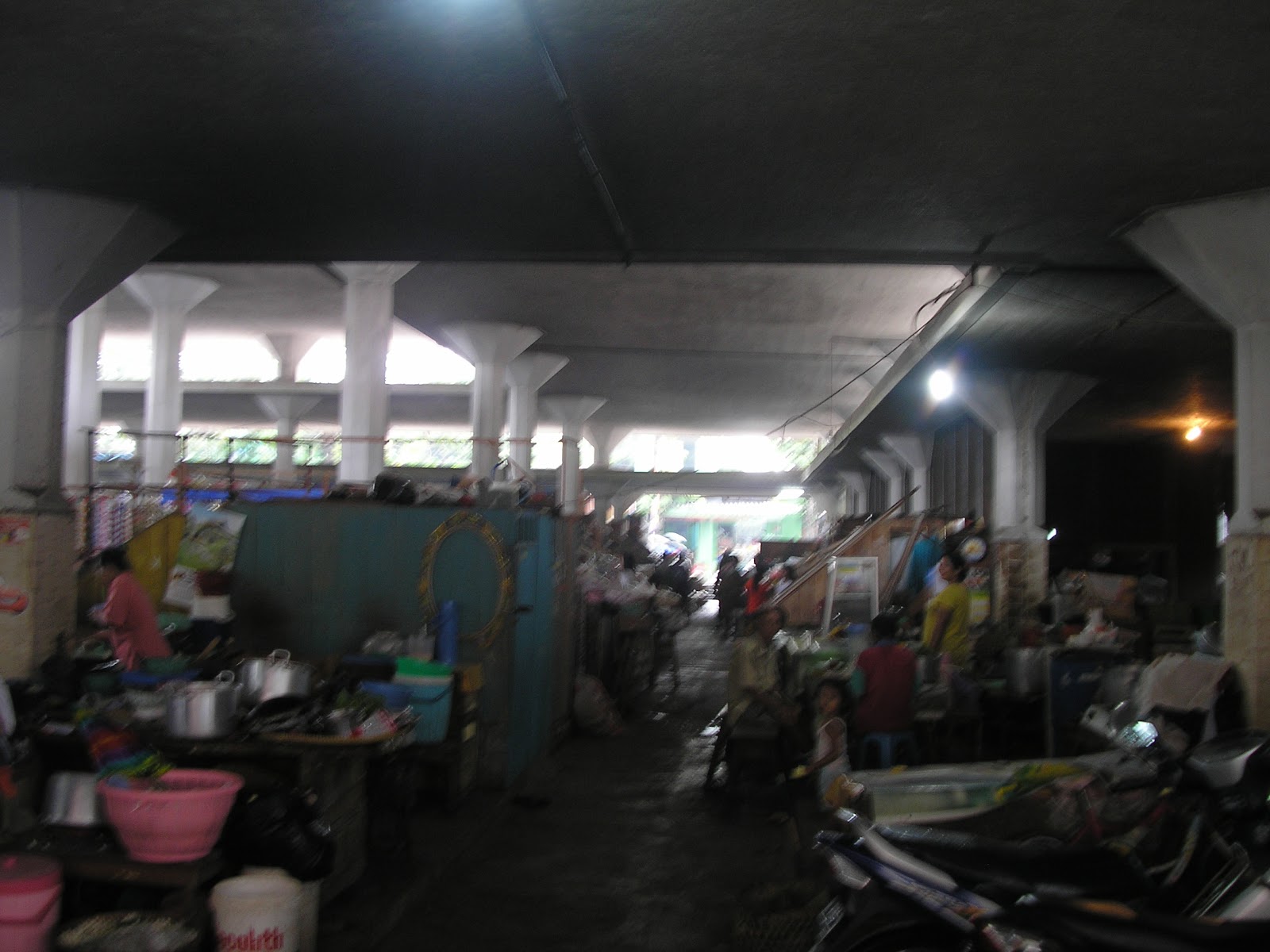
Nowadays, Pasar Peterongan is known as one of remaining traditional market in Semarang City. The existence of this traditional market is already found in old city master plan have prepared by the Dutch during Colonial Era. The market place is prepared and planned as one of important daily trading place in eastern side of Semarang City. Based from old vintage photo, there was originally a train railway existed at the foreground of the above picture.


The existence of many old market places in Semarang City are associated with the name of trees, such as Pasar Johar is related with the name of johar tree (senna siamea), Pasar Randusari is related with the name of randu or kapok tree (ceiba pentandra) and Pasar Jatingaleh might be related with the name of teak tree (tectona grandis). And the existence of Pasar Peterongan might be associated with the existence of an old tamarind tree, but in this case, the name of the the tree was not becoming the name of the market place. 


Currently, the old tamarind tree is directly situated behind the market office building. When somebody pass the main street, it looks like a green background over the market office building and shadowing messy traditional trader shelters behind. Local folktale told that this tamarind tree is much older than the current market building is.


Saturday, April 14, 2012

Siranda Resevoir; a Remaining Piece of Semarang War History


Siranda Reservoir is an old clean water reservoir built during Dutch Colonial Era. A lettering on the wall mentions a text of '1912', this may indicates that the building is already there since more than hundred years ago. 


Siranda itself is relates with an uphill road, a transition road that connecting Semarang's down town to upper town area. The reservoir building is actually a dome-roofed building that covers with green grass layers over. A small copula tower with ventilation louvers is situated on the peak and around the roof domes. There are two reservoir domes in Siranda Reservoir complex. The new on is built around the year of 1923.


The older dome is the bigger one with its interesting main entry facade. A strong symmetrical arrangement that consists of a double louvered timber door in the center of the facade within timber louvered windows at both sides. A plaster arch shapes are strongly dressing the entry facade of the reservoir building.


The Siranda Reservoir is noted as one of the important part in related with Semarang history in related with five days war against Japanese invasion in the year of 1945. There was an incident that involving a young medical doctor who killed by Japanese trooper when he tried to do a verification regarding poisoned reservoir water. Dr. Kariadi, the name of the heroic doctor finally is memorialized as a name of the main public city hospital in Semarang City.


Sunday, March 11, 2012

Snapshots to Flatterman's House at Kyai Saleh Street


This is an old house that is situated at the south-end side of Kyai Saleh Street, at the intersection with Veteran Street. The building looks prominence from the crossroad, a tower with hexagonal pyramid shape roof becomes one of the point of interest. The house is firstly owned by Flatterman Family , a Dutch family during Colonial Era.


A long balcony with rich details on its balsutrade at upper floor level is attached to main part of the building that is covered with a triangular prism roof shape. It seem somebody can have nice viewing from balcony level to the large courtyard in front of the house below.


The building looks nicely set-up behind the front courtyard. From Veteran Street point of view, the overall building shapes composition is till looks good, although most of the lower part of the house is currently covered by lush of trees, the hexagonal pyramid shape of the tower roof and the triangular shape belong to the house roof are pop-up side by side over the top of the trees.


Saturday, March 10, 2012

Pasar Randusari; a Remaining Old Market near the Cemetery Hill


As noted in the history, Pasar Randusari is one of market building in Semarang that is designed by Thomas Karsten, the Dutch Colonial Architect around the year of 1930. Currently, Pasar Randusari is known as one of remaining traditional market in Semarang that is situated about 700 meters from Pasar Bulu Market. 


This current location is close to the north-end side of Kyai Saleh Street, it situated less than 200 meters from an intersection road to Pandanaran Street, a main busy street in the center of Semarang City. The market building itself is also closely situated to Bergota Cemetery hill area, the largest cemetery in the city.


 In compare to Pasar johar and Pasar Bulu, Pasar Randusari is a market building in smaller size. The market building is just a simple building with as square shape plan in 40 meter by 40 meter size. There are about 56 columns with particular shape that support flat concrete roofs in 3 different split levels. Actually, this different flat roof leveling simply allow sunlight penetration to the center part of the building. 


This is the place for visitor not only find and buy daily domestic goods, but this is place for somebody to find street traders who sell red and white rose flowers for the needs of grave yard visit at the cemetery nearby.


Friday, March 2, 2012

Mandala Bhakti Museum; a Military Museum Today and Dutch Colonial's Courthouse in the Past Day


The building is close to where the Tugu Muda Monument and "Pasar Bulu" Market are currently situated. This a two storey building with a simple strong geometrical box shape under large clay roof in triangular prism shape. A very formal building shape, it might be related with building original function as a Court House during Dutch Colonial Era. As describe on historical notes, the building is originally known as "Raad van Justitie" and built around the year of 1930.
 

Nowadays, the building is a military museum, after many years is occupied as a regional military headquarters.This is maybe one of many old buildings from Dutch Colonial Era in Semarang that ever used for military facilities, including the famous "Lawang Sewu" Building that is situated across this museum building. A large military compound is situated behind the building including military housing and military hospital.


Museum Mandala Bhakti building is nicely place with deep setback against the main street within a large open courtyard in front of it. This front courtyard provides a nice visual exposure for every street walkers when they are passing by. It always make the building is visually appears in good visibility in any point of view around the "Tugu Muda" Monument.